How is AI affecting education and our rangatahi?
I want to preface this by saying that I have worked in education for the last 4 years. I have been in class pre-AI and have seen the effect it’s having on students, teachers and communities.
The ever-growing normalisation, use, and expansion of more AI programs is having a detrimental effect on education. AI undoubtedly has legitimate uses in education too, from accessibility support to easing teachers’ admin load, but it’s the unchecked pace of its growth that concerns me here. An Education Review Office report found that an estimated 90% of Principals and 80% of Teachers are using AI tools (RNZ , 2026) for generating slides, visual aids, emails, and writing reports. In fact, one of the tabs on Google Classroom is Gemini for educators, which has a series of prompts designed to “make life easier for educators”. Firsthand, I’m seeing teachers are becoming increasingly reliant on these tools to do the lessons for them. Students are getting frustrated, endlessly writing down AI-generated notes from slides. The vital human element is starting to disappear from teaching as a result.
Students are becoming increasingly reliant on AI tools to think for them. They are failing to use their critical faculties to question whether the information they are receiving is accurate or relevant (and in turn we are failing them). Our rangatahi know their way around technology, and as we know, AI checkers are notoriously inaccurate; it’s becoming increasingly harder to distinguish what AI-generated content is and what isn’t AI-generated content. Universities such as Massey are beginning to abandon AI detectors and checking systems, returning to in-person pen-and-paper exams to combat cheating.
Students are taking advantage of this using a range of different AI tools to complete their work, even for simple tasks such as creating posters. This is affecting their ability to engage with their schoolwork, classmates and teachers. It’s an uphill battle to push against this wave of AI without a clear, definitive framework or policy giving both teachers and students guidelines of what is and isn’t ok when it comes to using AI as a tool in education.
The rollout of AI tools extends both in and beyond the classroom. Teachers, students and communities are relying on AI-powered chatbots such as ChatGPT, Microsoft Copilot, Gemini (etc.), to seek advice, connection, and build resources. Interestingly, there is a series of concerning links to the overuse of AI tools by our rangatahi to reduced social wellbeing, emotional intelligence, and interpersonal skills (Klimova & Pikhart, 2025). As AI is an emerging tool, we don’t have conclusive studies to show the full effects of cognitive offloading, but the warning signs are there. A MIT Media Lab study showed users who rely on ChatGPT to help with academia, such as writing essays, have “consistently underperformed at neural, linguistic, and behavioural levels” (Kosmyna et al., 2025). This is a worry, as I feel we are only becoming more reliant on AI tools, especially in education, and we won’t see the full impacts of cognitive offloading until it’s too late.
AI in education isn’t going away, and treating it as a passing trend does students and teachers no favours. What our schools need is a framework, one that gives clear guidance on what responsible use looks like, before the consequences of leaving this unchecked become too late to reverse.
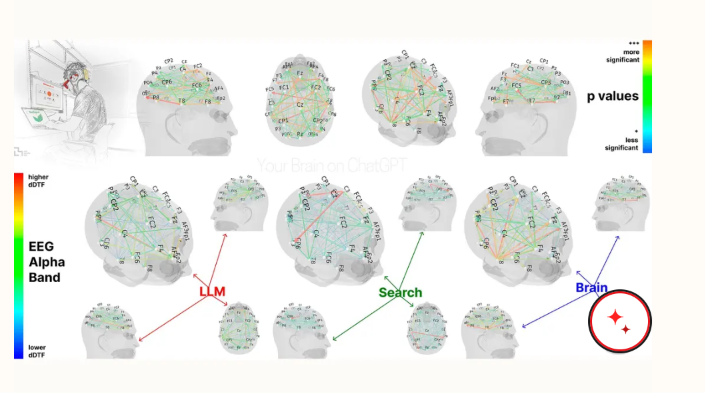
(Aforementioned MIT lab study)
Bibliography
Aotearoa, R. T. R. I. (2026, July 30). Teachers worried about critical thinking as AI becomes widespread in schools. RNZ. https://www.rnz.co.nz/news/education/836125/teachers-worried-about-criticial-thinking-as-ai-becomes-widespread-in-schools
Klimova, B., & Pikhart, M. (2025). Exploring the effects of artificial intelligence on student and academic well-being in higher education: A mini-review. Frontiers in Psychology, 16(16) https://doi.org/10.3389/fpsyg.2025.1498132
Chow, A. (2025, June 17). ChatGPT May Be Eroding Critical Thinking Skills, According to a New MIT Study. TIME; Time. https://time.com/7295195/ai-chatgpt-google-learning-school/
Kosmyna, N., Hauptmann, E., Yuan, Y. T., Situ, J., Liao, X.-H., Beresnitzky, A. V., Braunstein, I., & Maes, P. (2025, June 10). Your Brain on ChatGPT: Accumulation ofCognitive Debt when Using an AI Assistant for Essay Writing Task. arXiv.Org. https://arxiv.org/abs/2506.08872